ML Systems / LLM Inference

PagedServe

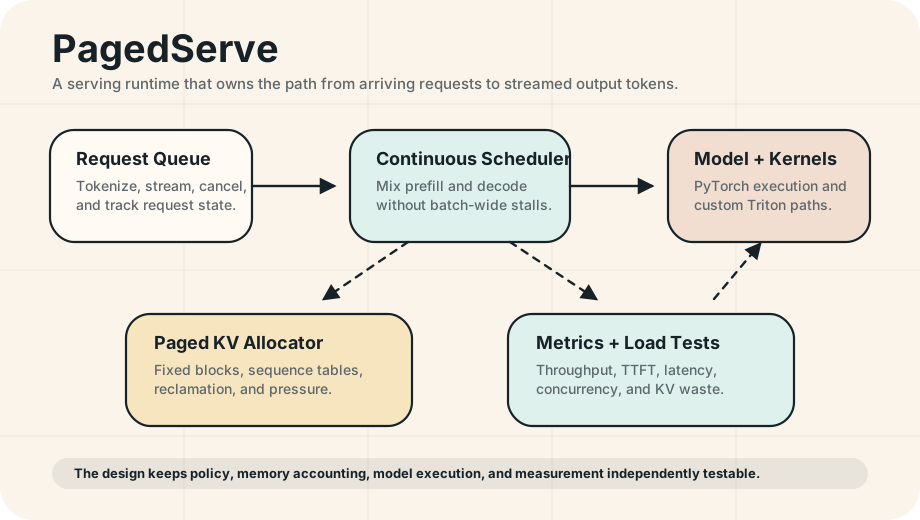
PagedServe is a from-first-principles LLM serving architecture. It owns request state, continuous batching, paged KV memory, prefill and decode scheduling, token streaming, and the boundary between model execution and custom kernels.
  • Python
  • PyTorch
  • Triton
  • CUDA
  • Prometheus

Five measurements that matter

Throughput

Aggregate output tokens produced per second.

TTFT

Time from request arrival to the first streamed token.

ITL

Inter-token latency after decode begins.

KV Waste

Unused capacity inside allocated cache pages.

Concurrency

Active sequences sustained under memory pressure.

Why this architecture

A call to model.generate(...) hides the most interesting serving problems. Real systems must decide which requests run at each token step, how long prompts share the GPU with active decodes, and how KV memory is allocated without reserving every sequence’s maximum possible length.

PagedServe separates policy from mechanics so the scheduler, block allocator, model loop, sampling path, and metrics can each be tested and compared without outsourcing the runtime to another server.

System Diagram

PagedServe request queue, continuous scheduler, model kernels, paged KV cache, and metrics

How serving works

1

Admit and tokenize

The API creates request state, tokenizes the prompt, and places the sequence in the waiting queue with its generation limits.

2

Schedule prefill

Prompt tokens are processed in bounded chunks so one long prompt cannot monopolize an entire scheduling iteration.

3

Continuously decode

Finished sequences leave immediately and newly eligible requests join later decode steps without waiting for a static batch.

4

Reclaim and stream

Generated tokens stream to the client while completed or preempted sequences return KV blocks to the free pool.

Key engineering choices

Own the generation loop

Hugging Face provides model weights and tokenization, while the runtime owns batching, sequence state, KV writes, and sampling.

Page memory explicitly

Fixed-size blocks, per-sequence block tables, reclamation, and pressure handling make memory use observable instead of implicit.

Compare one workload

Serial, static batching, continuous batching, and external baselines use the same model, precision, prompts, and outputs.

Performance model

Throughput is never read alone. A scheduler can produce more tokens by making individual users wait longer, so each experiment records throughput beside first-token latency, inter-token latency, request latency, KV occupancy, and concurrency. vLLM is an external baseline, while the primary comparison remains PagedServe’s own serial and static-batching paths.

Hire me!

You still here?

It’s over

Karan Bhaskar